

Barter transactions remain a practical way for businesses and individuals to exchange goods or services without relying solely on cash payments. While they may appear simple, barter deals in Georgia carry important tax implications. Under Georgian tax law, a barter transaction is treated as both a sale and a purchase for each party involved. This means that even if no money changes hands, tax obligations still arise.
Barter as a Taxable Transaction
When two parties exchange goods or services, each is regarded as having sold what they provide and purchased what they receive. The taxable value of such a transaction is determined based on the market price of the exchanged goods or services. This ensures that the economic substance of the transaction is properly recognized, regardless of the absence of cash.
For example, if a landowner transfers a plot of land and, in return, receives a portion of a newly constructed building together with a partial cash payment, the entire arrangement is still classified as a barter deal. In this case, the landowner is considered to have sold the land, while the developer is considered to have sold part of the building.
Tax Implications of Barter Transactions
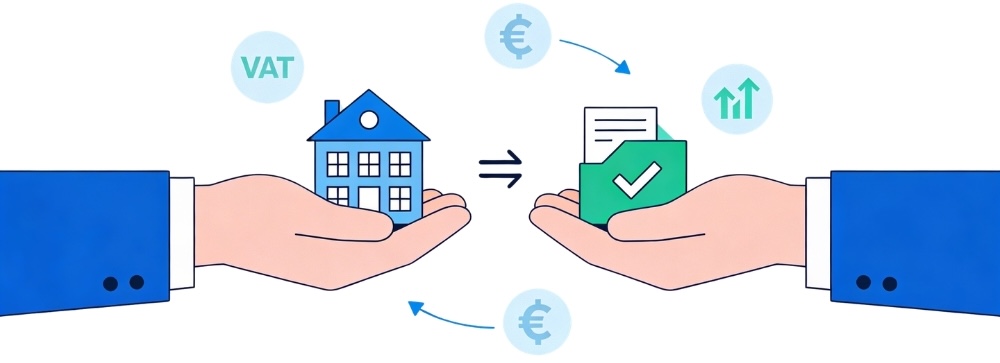
Barter transactions in Georgia are subject to Value Added Tax (VAT) when they meet the general conditions of taxable supplies. The taxable base is determined by the market value of the goods or services received, excluding VAT. If part of the consideration is settled in cash, the cash amount reduces the taxable base accordingly. Each party to the transaction must issue a tax invoice, which serves as the basis for VAT accounting and, where applicable, allows VAT deduction. In cases involving immovable property, such as land or buildings, the VAT base is calculated according to the market value of the received property, ensuring uniform treatment of real estate barter deals.
However, VAT is not the only tax consideration. Many taxpayers mistakenly overlook the income tax implications of barter transactions. When the items exchanged have appreciated, the difference between the market price at the moment of the exchange and the purchase price is treated as taxable income for each party. In such cases, that excess value – capital gain – is subject to income tax, in addition to the VAT obligations arising from the transaction.
For example, consider a case where a taxpayer acquires commercial real estate for USD 1 million, and later exchanges it in a barter transaction when its market value has risen to USD 1.5 million. Although no cash changes hands, the taxpayer realizes a capital gain of USD 0.5 million, which is subject to income tax in addition to VAT on the exchange. This illustrates a key risk of barter transactions: they may generate substantial tax liabilities without providing the liquidity to settle them. Careful planning is therefore essential to avoid unexpected cash flow challenges.
Timing of VAT Liability
Significant updates to the rules on the timing of VAT liability took effect from 1 January 2024. Under the new framework, VAT becomes payable in the tax period when compensation is received – whether in cash or in kind – even if this occurs before the delivery of goods or the performance of services.
For agreements concluded before 1 January 2024, the previous rules remain applicable. In such cases, VAT is triggered at the moment of delivery or performance. Where partial advance payments are made under these earlier contracts, VAT liability arises at the time of payment.
Key Takeaways for Barter Transactions

In Georgia, every barter transaction is treated as a taxable event, regardless of whether it involves goods, services, or property. Each party is viewed simultaneously as both a seller and a buyer, which means that both sides must recognize revenue and expenses based on the market value of what they give and receive.
Accurate invoicing is a critical part of compliance. Without proper documentation, businesses risk losing the ability to deduct VAT and may face penalties in case of an audit. Special attention is required for real estate barter deals, since the VAT base must reflect the fair market value of the property received.
Finally, individuals should not overlook income tax obligations: if one party exchanges an asset that has appreciated, the price difference is treated as taxable income. In short, parties must carefully document and evaluate barter transactions to stay compliant and avoid unexpected tax bills.
While barter transactions can be a practical way to structure business arrangements, they carry specific and sometimes overlooked tax consequences. It is essential that companies and individuals properly assess the market value of exchanged items, not only for VAT purposes but also to identify any potential income tax liability.
By carefully managing valuation, VAT compliance, and income tax obligations, taxpayers can avoid unexpected liabilities and ensure that barter transactions remain a legitimate and efficient tool for commercial exchange.
Disclaimer: This article is based on Georgian legislation and publicly available information as of September 2025. It is intended for informational purposes only and does not constitute legal or tax advice. Readers should seek professional guidance tailored to their specific circumstances before acting on the information provided.