
In Georgia’s fast-developing real estate sector, it is common for development companies and landowners to enter into complex contractual arrangements involving the exchange of land for completed residential or commercial spaces. While some transactions are structured as traditional sale-and-purchase agreements, barter arrangements are far more frequent in practice.
Under such deals, the landowner transfers ownership of a plot of land to the developer and, in return, receives one or more completed residential or commercial units within the newly constructed building, or in some cases, a mix of property and partial cash compensation.
Although these arrangements may seem commercially straightforward, they carry complex tax implications under Georgian law, particularly in relation to Value Added Tax (VAT) and income taxation.
For a deeper understanding of how the sale of completed or unfinished residential units is taxed in Georgia, you may also refer to our publication on tax obligations arising from the sale of residential property.
Legal Nature of Barter Transactions
Under the Georgian Tax Code, a barter transaction is treated as both a sale and a purchase for each party involved. This means that even when no money changes hands, both the landowner and the developer are considered to have made taxable supplies.
For example, if a landowner provides a plot of land and receives several apartments or commercial spaces in return, the landowner is deemed to have sold the land, while the developer is considered to have sold the corresponding part of the building.
VAT Implications
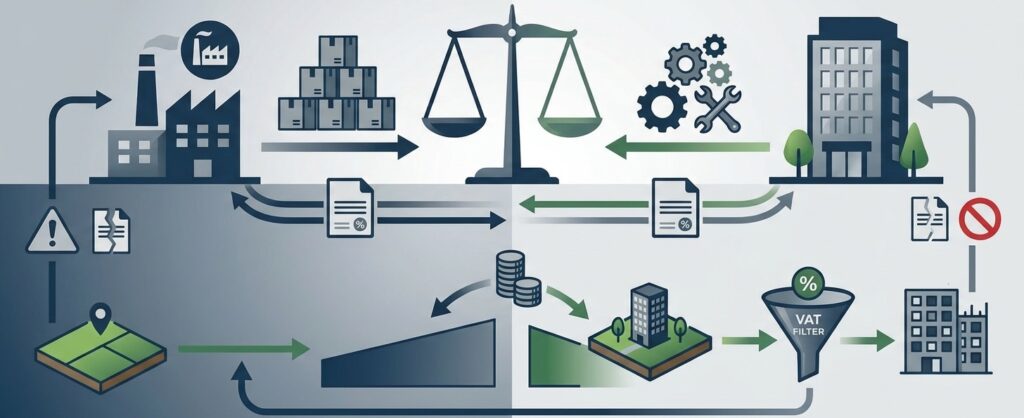
Barter transactions are subject to VAT when they meet the general conditions of taxable supplies. The taxable base is determined by the market value of the goods or services received, excluding VAT.
If a portion of the payment is made in cash, that amount reduces the taxable base for VAT purposes. Each party must issue a tax invoice that accurately reflects the fair market value of the property exchanged, since this serves as the basis for VAT reporting and, where applicable, for claiming input VAT deduction.
In real estate barter arrangements, VAT is calculated based on the market value of the received property. This approach ensures neutrality and consistency in the taxation of real estate exchanges, regardless of whether payment is made in cash or in kind.
It is important to note that the supply of land is exempt from VAT, but without the right of deduction. This means that while land transfers do not trigger VAT obligations, the supplier cannot claim VAT input credits related to the exempt transaction. However, if a building stands on the land plot and the owner sells the land together with that building, the transaction will be regarded as a supply of the building and will therefore be subject to VAT.
In practice, another common issue arises with the resale of unfinished apartments. Individuals or entities who receive partially constructed residential units from a developer and subsequently sell them often mistakenly treat this as a financial transaction, rather than the supply of goods. However, under Georgian VAT rules, such transfers constitute a taxable supply of goods and are therefore subject to VAT, just like the sale of completed property.
Failure to issue or properly record invoices can result in loss of VAT deduction rights and potential penalties during tax audits. Therefore, proper documentation and accurate market valuation are essential compliance requirements.
PIT and CIT Considerations

While VAT is often the most visible part of the tax burden in barter transactions, personal income tax (PIT) and corporate income tax (CIT) implications are equally significant.
If the exchanged property has appreciated in value, the difference between its current market value and the original acquisition cost is treated as taxable income. This rule applies both to individuals and companies.
For instance, if a landowner initially acquired a plot of land for USD 100,000 and later transfers it in a barter deal when its market value has increased to USD 200,000, the gain of USD 100,000 represents taxable income. The same principle applies to the developer if the construction costs of the transferred apartments are lower than their market value at the time of exchange.
For companies operating under Georgia’s Estonian-style Corporate Income Tax system, the taxable effect arises only when profits are distributed or used for non-business expenses. Thus, a development company selling or bartering property recognizes CIT obligations at the time of profit distribution, not at the time of the barter itself. However, once the profit is distributed, it is taxed at 15 percent CIT, followed by a 5 percent withholding tax on dividends when paid to shareholders.
Barter transactions between developers and landowners are an essential tool in Georgia’s construction and real estate industry, but they come with significant tax implications. Understanding how VAT and income taxes apply to such exchanges is crucial for managing risk and avoiding unexpected liabilities.
Careful tax planning, supported by professional valuation, proper contract structuring, and timely documentation, can ensure that both parties benefit from the arrangement without triggering unintended tax consequences.
Disclaimer: This article is based on Georgian legislation and publicly available information as of October 2025. It is intended for informational purposes only and does not constitute legal or tax advice. Readers should seek professional guidance tailored to their specific situation before acting on the information provided.