
Georgia has developed a robust legal framework for intellectual property protection. The cornerstone of this framework is the Law of Georgia on Copyright and Related Rights (the “Copyright Law”), which governs the creation, use, transfer, and licensing of intellectual property. The National Intellectual Property Centre of Georgia („Sakpatenti“) serves as the primary regulatory authority responsible for implementing state policy in this field.
The Copyright Law protects scientific, literary, and artistic works resulting from intellectual and creative activities. This encompasses a broad range of works, from books, articles, and computer programs to musical compositions, audiovisual works, architectural designs, photographs, and databases.
Granting Permission to Use IP
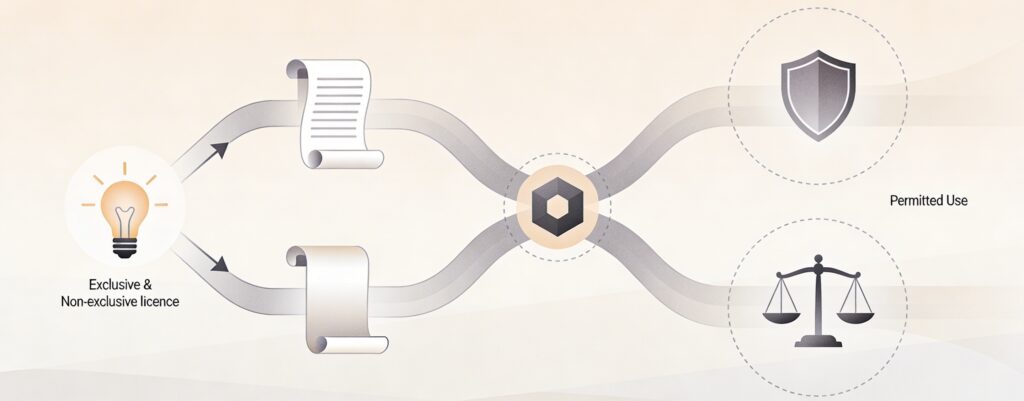
Copyright Law provides several mechanisms for authorizing the use of protected works.
Copyright Transfer
Authors and copyright holders may transfer all or part of their property rights to successors through contract, testamentary succession, or by operation of law. While economic rights may be transferred, personal non-property rights-such as the right of authorship and integrity-cannot be inherited, though heirs may protect these rights on the author’s behalf.
Exclusive License
An exclusive license grants the licensee sole rights to use the work in a specified manner, including the power to prohibit use by others, even by the author. That said, an author who has granted an exclusive license retains the right to include the work in a complete collection of their works after five years from initial publication.
Conventional (Non-Exclusive) License
Under a conventional license agreement, an author or copyright holder grants the licensee the right to use the work on an equal basis with other persons who have received the right to use the work similarly. A right transferred under a copyright agreement shall be deemed to be a conventional right, unless otherwise provided in the agreement.
License Agreement Requirements
A license agreement must provide for an exact description of the work to be used, including title, size, and genre, as well as the specific form of use of the work. The agreement must also specify the validity term and the territory covered, as well as the procedure for determining the amount of royalties for each form of use and the procedure and time of payment. Parties may also include other conditions they deem essential.
Georgian law establishes several important default rules for license agreements. The right to use the work in any form not expressly set forth in the license agreement remains with the author or copyright holder. If the agreement does not specify a term, the author may cancel it three years after conclusion, provided six months’ written notice is given to the licensee. Where the agreement does not specify the territory, it shall be valid only in Georgia. Additionally, rights granted under a license agreement may be transferred to other persons only if expressly provided in the agreement.
Royalty Determination
The amount of royalties, the procedure for calculation, and payment for use of a work shall be established under an agreement concluded between the author, another copyright owner, or organizations managing property rights on a collective basis (the „Collective Management Organization“)on one hand, and the user on the other. If the Collective Management Organization and the user fail to reach an agreement, the amount of royalty shall be determined by a commission created by the order of the chairperson of Sakpatenti.
Collective Management of Rights
Under the Copyright Law, authors, performers, phonogram and videogram producers, and other holders of copyright and related rights may establish an organization managing property rights on a collective basis. Such Collective Management Organization shall non-entrepreneurial (non-commercial) legal entity to which Sakpatenti grants accreditation. Effective from 1 January 2024, Intellectual Property Owners Association (IPOA) is the sole and exclusive Collective Management Organization on the Georgian market.
The Collective Management Organization is authorized to conduct negotiations with users about the amount of royalties and terms of use, issue licenses to users for the use of works within the scope of their mandate, and collect royalties based on licenses granted. They are also responsible for distributing and paying collected royalties to right holders in a timely manner and representing right holders’ interests in courts and administrative bodies.
The maximum amount of rights management fee shall not exceed 20 percent of the royalties collected.
Permitted Uses Without Permission
Certain uses of copyrighted works are permitted without the author’s consent and without paying royalties. These include quoting works for scientific, research, polemic, critical, or information purposes, to the extent justified by the purpose, and using excerpts in publications, radio and television programmes, and instructional recordings for educational purposes. The Copyright Law also permits reproducing articles on current events in periodicals, unless prohibited by the author, reproducing works for court proceedings to the extent specified by the purpose, and public performance of musical works during official, mourning, and religious ceremonies.
Protection and Enforcement
Infringement of copyright, related rights, and the rights of a database producer leads to civil, administrative, and criminal liability. Right holders may require the offender to recognize their rights, restore the status quo existing before the infringement, and seize counterfeit copies and materials used for reproduction. Additionally, right holders may seek compensation for losses, including unearned profits, or alternatively request one-time monetary compensation instead of compensation for damages.