
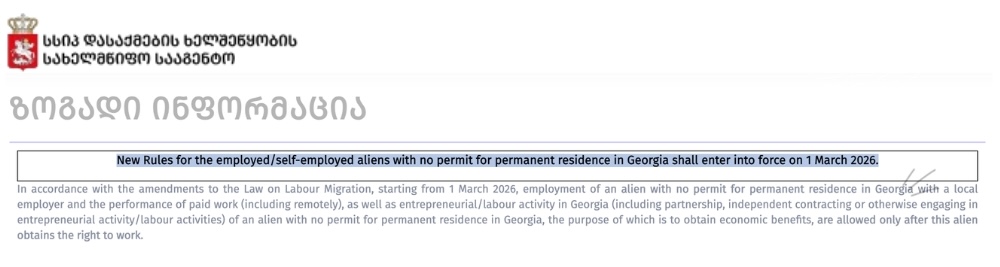
Effective March 1, 2026, the Government of Georgia is fundamentally reshaping how foreign nationals can work in the country. Resolution No. 70, adopted on February 20, 2026, together with the amended Law on Labor Migration and the Law on the Legal Status of Foreigners, establishes a comprehensive new framework requiring labor immigrants and self-employed foreigners to obtain a formal “right to work“ before engaging in any paid employment or entrepreneurial activity in Georgia.
- Since 1 March 2026, foreign nationals need a formal right to work in Georgia.
- Permits are tied to a specific employer and position, or to a field of activity for the self-employed.
- Employers must usually advertise the job for 10 working days before applying.
- Decisions take 30 calendar days, or 10 working days under the expedited procedure.
- Existing labor immigrants must have a permit and residence permit by 1 January 2027.
Who Is Affected?
The new regulations distinguish between two categories of foreign workers:
- Labor immigrants: foreigners employed by a local Georgian employer in a paid position must obtain work authorization tied to a specific employer and a specific position.
- Self-employed foreigners: those engaged in trade, services, independent contracting, or other entrepreneurial activities from which they derive financial benefit– must obtain work authorization tied to a specific field of activity.
Certain categories remain exempt, including refugees, people with international protection, diplomatic personnel, accredited foreign media workers, and holders of active investment residence permits.
Labor immigrants
Employed by a Georgian employer. Permit tied to a specific employer and position.
Self-employed foreigners
Trade, services, contracting and other income activity. Permit tied to a field of activity.
Exempt groups
Refugees, international protection, diplomats, accredited foreign media, investment residence permit holders.
The Labor Market Test: Locals First
One of the most significant changes is the introduction of a labor market test. Before an employer can apply for a work permit for a foreign worker, the employer must first post the job opening on Georgia’s official employment portal (worknet.moh.gov.ge) for a minimum of 10 working days to seek qualified local candidates. The State Agency for Employment Promotion of the Ministry of Internally Displaced Persons from the Occupied Territories, Labour, Health and Social Affairs (hereinafter referred to as the Agency) will search its own database for suitable local candidates and present them to the employer, who must justify in writing any refusal to hire a proposed local candidate.
The labor market test does not apply to: (i) companies with international company status under Article 23 of the “Tax Code of Georgia”; (ii) companies with innovative startup status under the “Law on Innovations”; (iii) international experts who are members of the Higher Education Institution Authorization and Educational Program Accreditation Expert Corps; and (iv) positions where the monthly salary exceeds 15,000 GEL (accrued amount) and the employer requires higher education in a specialty directly related to the work. However, even where the salary threshold is met, the Agency may reimpose the labor market test if the necessity of the work being performed personally by the specific foreigner is not evident, after coordinating with the Ministry of Economy and Sustainable Development.
Application Process and Timelines

All applications to obtain a formal “right to work“ must be filed through the dedicated electronic system (www.labourmigration.moh.gov.ge), managed by the Agency. For self-employed foreigners, a video interview with the Agency is mandatory before the work rights can be issued.
The Agency must issue a decision within 30 calendar days of receiving a complete application under standard procedure, or within 10 working days under an expedited procedure.
The process of granting the right to work (submission of an application, information and documents, payment for services, notification of decisions, etc.) shall be carried out through an electronic system on a special portal: www.labourmigration.moh.gov.ge
Decision on a standard work permit application
Faster decision under the expedited route
Duration and Renewal
A first-time work permit for a labor immigrant or self-employed foreigner (other than those in the IT sector) is valid for 6 months to 1 year. For foreigners employed or self-employed in the information technology (IT) sector, the initial work right may be valid for up to 3 years. The work permit enters into force upon the foreigner obtaining a D1 category immigration visa or a labor residence permit (or, for IT-sector workers, a residence permit for IT-sector employees). For foreigners who already hold a residence permit at the time of application, the right enters into force from the date of issuance by the Agency.
- For non-IT workers, the permit may be extended for up to 1 year at a time during the first five years of continuous validity. After five consecutive years of extensions, each subsequent extension may be granted for a period of 1 to 5 years.
- For IT-sector workers, extensions may be granted for up to 3 years at a time. Renewal applications must be filed no later than 30 calendar days before the current permit expires.
| Non-IT sector | IT sector | |
|---|---|---|
| First permit | 6 months to 1 year | Up to 3 years |
| Extensions | Up to 1 year at a time for the first 5 years, then 1 to 5 years | Up to 3 years at a time |
Quotas for Certain Sectors
The government has introduced annual quotas for professions where the local labor supply meets or exceeds demand. Notably, quotas for courier services, passenger transport operators, and tourist guides are set to zero, effectively banning new foreign workers in these fields. Mountain, alpine, and ski guides are capped at 200 permits annually.
Courier services
Passenger transport operators
Tourist guides
Mountain, alpine and ski guides per year
Transitional Provisions
Self-employed foreigners who were already conducting business in Georgia as of March 1, 2026, including active company partners, will have until May 1, 2026, before enforcement mechanisms are activated against them. Labor immigrants already registered in the Ministry’s database with active registration status must obtain a work permit and corresponding residence permit by January 1, 2027.
Already operating on 1 March 2026: enforcement begins
Already registered: work permit and residence permit required
What the New Framework Means in Practice
Georgia’s new labor migration framework represents a significant shift in the country’s regulatory approach to immigration. The framework moves from a largely open labor market to a structured, permit-based model designed to regulate foreign employment. The stated objectives include protecting the local labor market and ensuring that foreign employment serves genuine economic needs. Key features of the new system include profession-specific quotas, a mandatory labor market test for certain positions, and defined timelines for visa and residence permit applications.
Notably, the framework’s most restrictive measures, including the labor market test, annual quotas, and zero quota bans, are directed primarily at non-highly qualified personnel and sectors, where local labor supply already meets or exceeds demand, while highly qualified professionals, IT sector workers, international companies, and innovative startups benefit from significant exemptions and more favorable terms.
While a work permit allows legal employment in Georgia, tax obligations depend on residency status. You can read more in our article on Georgian tax residency rules.
About Andersen in Georgia
At Andersen Georgia, we advise employers, foreign professionals and self-employed individuals on Georgia’s labor migration rules. Our team supports clients with work permit and residence permit applications, the labor market test, renewals and transitional deadlines, and the tax implications of working in Georgia.
Get Work-Ready.
From the labor market test to permit applications, renewals and transitional deadlines, our team helps employers and foreign professionals work legally in Georgia.